# Save Game: Preserving Polish Computer Culture of the 1980s and 1990s
You can copy an old game or demo, put it online and make sure there are backups. Then someone tries to run it, asks where it came from, or wonders why it looked different on the computer they remember.
At NRG 2026, I moderated Save Game, a discussion about preserving Polish computer culture of the 1980s and 1990s. My guests were Radosław “Radi” Padzik, who maintains the Amber/Klosz archive, and Maciej Grzeszczuk, involved in preserving home computer history and the long-running Atariki encyclopedia.
Between them, they have spent years keeping old software and the knowledge around it available. We talked about how that work starts, what happens when the machines behind it get old too, and who can carry it on.
What follows is an edited account based on the panel transcript. The quotations have been translated from Polish and lightly edited for readability; some have been shortened without changing their meaning.
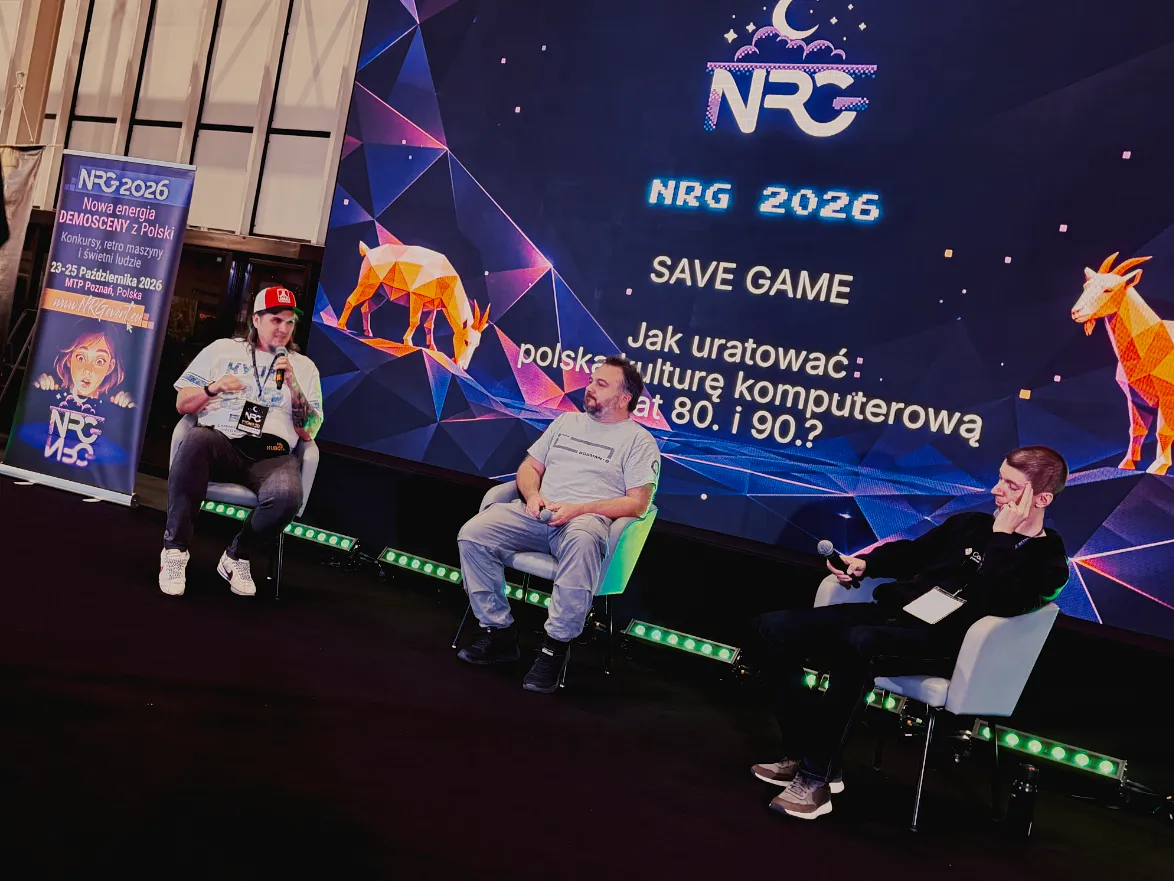
Panel participants on stage at NRG 2026.
Watch the panel recording from 1:21:42.
Once a demo is online, with copies in repositories and perhaps a mirror on the Internet Archive, it is in a much safer place than it was on a single floppy disk. The disk can fail without taking the only copy with it.
But give that file to someone who was not there, and they may have a few questions.
Maciej put it this way:
It is certainly protected against physical destruction. Magnetic media used to deteriorate over time. But it won’t be preserved for future generations unless those generations understand the context in which the work existed.
What machine was it made for? Why did its authors go to the trouble of making that effect work? What was happening around it? The binary will not tell you much about any of that.
Maciej compared an unexplained collection to a bag of objects found in a grandfather’s basement. To the grandfather, each object meant something. His children might still remember what it was for. His grandchildren might just see a bag of junk.
With a demo, even knowing which machine to run it on may leave you wondering what you are looking at. Radi suggested saving things the authors rarely thought worth publishing at the time: source code, for example, or fragments showing how an interesting effect worked. You can watch the result and then see how somebody persuaded the machine to produce it.
Before most of us had internet access, demos travelled on disks exchanged at parties and in packages sent through the post. There were BBSes too, and eventually FTP servers. Swapping meant knowing people and keeping up correspondence; finding a file on a server was a different experience.
Radi remembered the transition:
We were moving away from that wonderful period of swapping, with its very personal, individual correspondence. Other methods of direct communication appeared: IRC, newsgroups. Access to productions changed, but so did the context in which they circulated.
One early Polish demoscene FTP server was Crimson, in Gdynia. It brought together productions previously scattered across private collections, hard drives and floppy disks. You no longer had to know the person with the right disk, or someone who knew them.
Recent party releases appeared in directories. People uploaded files to incoming, where someone had to sort them out. At first the server gave new productions somewhere to go and people somewhere to find them. Its role as an archive grew over time.
Then Crimson went offline. Radi had a way to continue it:
I felt somewhat responsible for continuing it, especially since I had the opportunity. I was computerizing a company where I could run a server. It was the first Linux server I had ever set up. That was in 1998.
Amber, also known as Klosz, started there in 1998. Nearly thirty years later, Radi was still finding ways to keep it available.
I felt that this was the right moment to start building an archive. Something more substantial, something that would last, where everything could be kept together. Something worth keeping alive at all costs.
The machines went wherever there was room for them: companies, universities, public institutions, places with a friendly administrator. During the panel, I recalled that my own server had once lived at the Main Library of the University of Gdańsk.
Much of the early Polish internet depended on somebody knowing somebody who could provide a machine and a connection. Those arrangements helped keep a lot of material available.
Of course, FTP servers tell only part of the story. For software in Poland, there were also computer markets and studia komputerowe — small businesses selling copies.
As Maciej reminded us, getting a computer in the 1980s was difficult enough. Machines arrived through private imports, Pewex foreign-currency shops and limited domestic distribution. Then you needed something to run on it.
I recently checked a catalogue from 1988. There wasn’t a single legally distributed program in it. Hardly surprising, considering that an original game cost between twenty and thirty dollars, roughly one and a half months’ wages.
Much of what people used came as copies, often with the original protection already removed. Programs brought from abroad were duplicated and sold at markets and local shops. The market on Grzybowska Street in Warsaw was one important centre; people went there for software, but also exchanged knowledge, made contacts and learned what their computers could do.
Maciej questioned how central BBSes really were to mass distribution in Poland. Not everybody had a telephone connection, and people could wait years for one. A computer market or a nearby copying business was considerably easier to reach.
As for choosing a game, the catalogues did their best:
There were entries like “Chuckie Egg — a man walks around collecting eggs”, or “a little guy collects diamonds”, or simply “a good shoot-’em-up”. And that was what we based our purchasing decisions on.
There was no original manual to take home. Sometimes, for an additional fee, you could get a sheet describing the program and its keyboard controls. Occasionally, there was even a hand-drawn screenshot.
The discussion touched on the legal status of software before Poland’s 1994 Copyright and Related Rights Act. As Maciej noted, earlier legislation did not explicitly regulate computer programs in the same way. That does not mean copyright protection was entirely absent before 1994. The legal status of software and the realities of its distribution are related, but separate historical questions.
Amber/Klosz and Atariki began with a small number of people doing something they thought was worth doing. As more people came to rely on the resources, the administrative and financial responsibility often remained personal.
Radi has moved Klosz between servers, data centres and employers. Sometimes it went offline:
There were difficult moments, times when the server wasn’t running. But I always wanted to bring it back somewhere, whether on a new server, in another data centre, at a company where I worked or somewhere friendly that could provide the resources.
There were always new productions, new parties and new things to add. The scene was still going, and Radi kept finding somewhere to bring the archive back.
But a resource that depends on one person needs a way to continue when that person is no longer available. That is not a criticism of the maintainer; it is something the rest of us can help with. An institution might provide support, or people might share responsibility, document the infrastructure and keep independent copies, with enough information for someone else to reconstruct the service.
For years, independent cultural projects used the art.pl domain, and the archive was known as klosz.art.pl. Changes associated with the domain’s commercialization eventually forced it to move. Radi gave its current address during the panel: ftp.wireland.org.
The files made the journey. The links in old diskmags, websites, forum posts and production documentation did not. Someone following one of those references might reasonably conclude that the archive had disappeared, even though it is still available elsewhere.
In July 2026, the server hosting Atariki at Hetzner failed. The encyclopedia had already spent more than twenty years moving between infrastructure provided by various institutions and companies.
At one point it lived at the Faculty of Psychology of the University of Warsaw. For a time, it was hosted at Polskie Sieci Elektroenergetyczne, Poland’s electricity transmission system operator.
The data survived. There were backups, and the disks could be moved. Getting the encyclopedia running again was less straightforward: Maciej described a sixteen-year-old operating system, old libraries and an equally old MediaWiki installation.
That version of MediaWiki was thirty-seven releases behind the current database structure. There was absolutely no way to get it running with the old libraries.
Putting the disks into another machine was not enough. The application and its data structures needed a substantial migration, which was eventually completed. As Maciej put it:
When we create a database or a collection of information about historical objects, that collection itself becomes a historical object from the moment it is created. It needs conservation and maintenance, just like the objects it describes.
Radi has seen people download the whole of Klosz: the logs showed someone making a complete copy. We do not know where all those copies are now, but they may be useful if the server is ever unavailable.
Atariki provides regular snapshots that people can keep independently of the live service. Maciej would like to see copies spread further:
The only way to preserve this for future generations is to have it distributed through torrents, on archive.org, wherever possible. The more people who back it up, the better.
An FTP archive is relatively straightforward to mirror. A web forum is more complicated, even though its discussions can hold answers found nowhere else: why a machine behaves a certain way, how an effect was made, who was involved in a production, or what different people remember about it.
Maciej suggested that administrators consider publishing regular database snapshots instead of leaving preservation entirely to people scraping the public website. That needs care: a database can contain private messages, personal information and material whose authors did not agree to unrestricted redistribution. A copy kept for preservation cannot automatically be published unchanged.
You find a cassette with River Raid on it. There are already plenty of copies of the game online, so is this one worth saving?
Maciej described what Polish computer shops sometimes added to their copies:
River Raid as a game is already available online. But River Raid was distributed by a hundred different computer shops, and half of them added their own messages: “Only the best software here! Open from 1 p.m. to 4 p.m. at the Phoenix department store. Come and visit!”
The cassette might also contain a particular crack, a modification or other material. The game may be familiar, but the recording can tell us which shop sold it and how it reached people who could not buy it through the original distribution channels.
Mail-order catalogues, press advertisements and computer market documentation can tell us more about that world. Much of this material was never systematically collected.
Before trying to find out what is on a cassette, there is the cassette itself to consider. Reading ageing media can damage them; in extreme cases, an unsuccessful attempt can destroy some of the information you wanted to recover.
Maciej’s advice was to capture the signal first, as faithfully as possible:
What we can do is preserve the audio, try to capture it in the best possible quality, and only then start experimenting with it.
Then the decoding experiments can happen on the digital copy, without running the original through the machine for every attempt. Even identifying the target computer may take work: different platforms encoded data on tape differently. A working recorder and the play button are only part of the job.
Fortunately, the person with the cassette does not have to know how to do everything. Maciej suggested dividing the work: someone with a suitable tape recorder captures the audio, someone who understands the encoding recovers the program, and someone else identifies it, finds out where it came from and documents the context.
They do need to be able to hand the work on. The person decoding the audio needs to know what was recorded and how; the person documenting the program needs the recovered material and whatever is known about the original carrier. The skills are already spread across people and projects. Connecting them lets each person contribute without having to become an expert in every part of the process.
Maciej remembered Lode Runner on the Atari as a colourful game. Years later, he obtained another version and found himself looking at black-and-white graphics.
The American version used NTSC artifacting: characteristics of the analogue video signal could produce additional colours. In a different execution and display environment, those colours did not appear. Similar differences in hardware and computer models can affect sound, timing and behaviour too.
The game ran, but it did not look the way he remembered. And even when we get the picture and sound right, there is more to an experience than what the machine puts out. Maciej suggested recording that too:
Ideally, we should record how excited we were about it. People gathered at a party, watching Numen or Rewind for the first time, shouting “Encore! Encore!” because they had never seen anything like it.
If we only record the screen, the shouts of “Encore!” are the first thing we lose.
Radi returned to the experience of watching productions together:
I remember the first demoparties I attended, and the biggest events, where we watched demoscene productions together with more than a thousand people, on a huge screen, with fantastic sound.
Watching a production at home cannot bring back its premiere or the conversations afterwards. Parties are also where people meet collaborators, compare techniques and bring newcomers into the scene.
Radi did not leave much doubt about how he felt:
Without demoparties, I would go as far as saying that this culture would simply die. So love demoparties, support demoparties, go to demoparties.
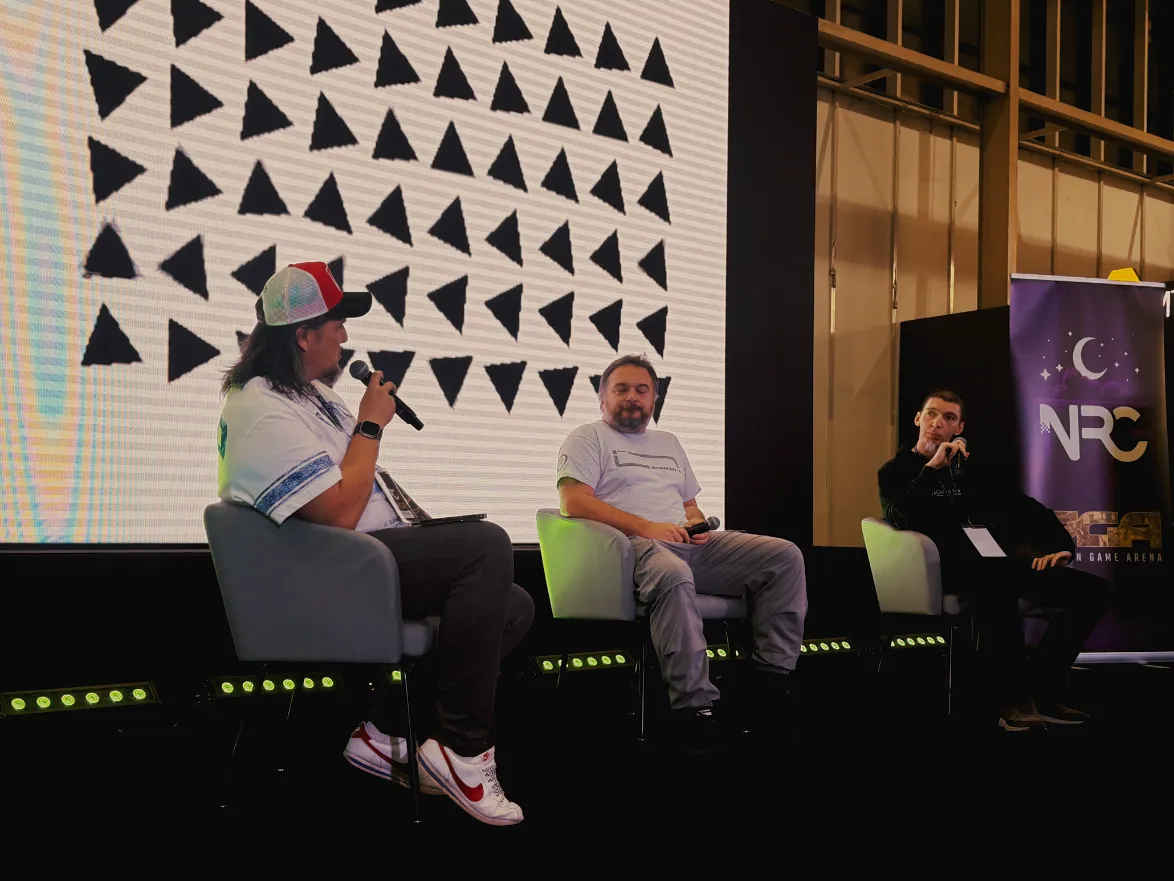
Panel participants on stage at NRG 2026.
I wrote about the demoscene as living heritage in a recent post. In December 2021, the Polish demoscene was inscribed on Poland’s National List of Intangible Cultural Heritage. That recognition includes the knowledge, skills, relationships and ways of doing things together — the work that continues at parties and between them.
What stayed with me was how often these stories came down to someone finding a place for a server, keeping a copy or knowing how to read a tape. A lot survived that way. But after nearly thirty years, we should be able to offer those people more than our appreciation and another request to bring the server back.
Keeping independent copies, documenting how a service works, helping with a migration — these are things the rest of us can take on. They give the next person somewhere to start, rather than another basement full of unexplained objects.
And there are still productions to make and parties to go to. I would rather we kept giving the archives more work.
Save Game — Preserving Polish Computer Culture of the 1980s and 1990s, NRG 2026.
Participants: Radosław “Radi” Padzik — Amber/Klosz archive; Maciej Grzeszczuk — Atariki and computer history preservation.
Moderator: Andrzej “angelo” Lichnerowicz.
The panel begins at 1:21:42 in the YouTube recording.
This blog post is based on the panel transcript. Quotations have been translated from Polish and lightly edited for readability. Some passages have been shortened while preserving their original meaning.